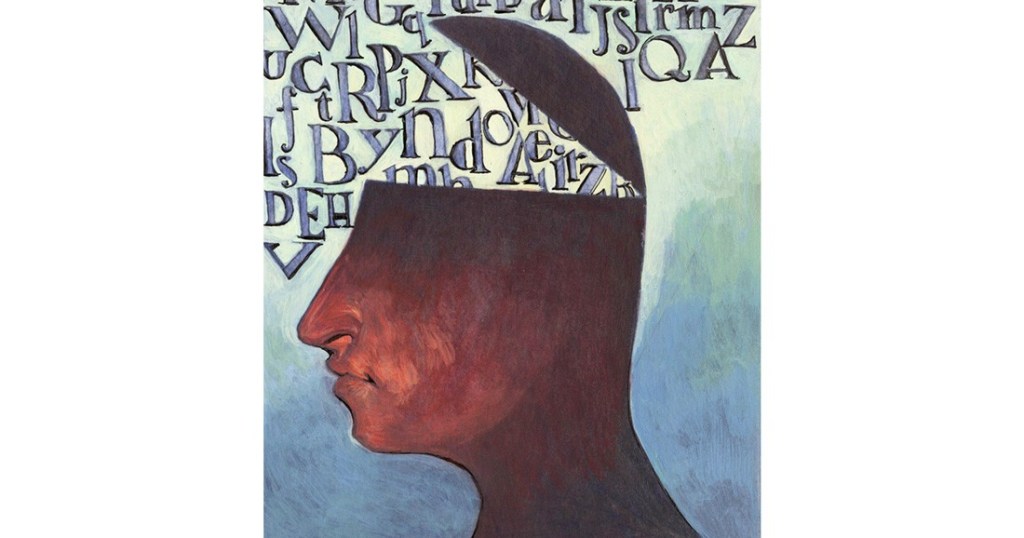
A language might have a million words, but all those words don’t matter. You need a sub-set of them in your whole life. A still smaller sub-set of them for your professional work, possibly in thousands. A still smaller sub-set which focus your learning on, possibly in hundreds. And them come the think-words – the ones which you really care about, with which you need to have an emotional connect, with which it’s worth spending more and more time.
In the testing world, I see many such words (and I share a list of some of them later in this article) that are think-words for me. What I also see is how many of these have been converted to be keywords and terms and how their definitions are exchanged and quoted, without a personal relationship with these words.
Borrowed learning helps only till a certain extent. Experiential learning needs to come into play, so that it is closer to where it can start helping you. Borrowed definitions have the same limitation. For example, just because you like one definition by someone does not mean you will/should like the next one by the same someone. This process of blind liking and borrowing soon becomes dogmatic without you even realising it.
What are the Think-Words for Testers?
I don’t know all of them as of writing this line. Even for myself. I’m trying to partially jot them down as a part of this article. The goal is not to find all of them. The goal is to understand yourself in relation to these words and then make this a habit.
You’ll need to find them for yourself without creating a ritual out of it.
There could be many. I like to take a minimalistic approach here. Rather than collecting 100 words which represent finer split of a higher level word, I’ll stick to one. That keeps me away from over-categorisation. It also helps me in uncaging concepts, as discussed in the previous article.
Some Think-Words For Me
These are some words that I care about, that trigger deeper thoughts in my mind. When I am solving a testing problem, a lot of these words act at the same time and I need to make sense of them. When I read a book or listen to anyone, what I consume feeds back to multiple of these words. That’s how I locate contradictions. That’s also how I get new ideas.
These are not in any order, although while writing some related words naturally came together. I am jotting them as I am trying to recollect, read my own mind. There are no definitions, of course.
At this stage, don’t worry about the list too much. This is my list. Just go through it to appreciate the sheet randomness of these words.
- I/Me
- Infinity
- Uncaging
- Human
- World
- Business
- Technology
- Quality
- Testing
- Contradiction
- Trade-off
- Attribute
- Test
- User
- Start
- End
- Time
- Cost
- Object
- Double
- Visualisation
- Model
- Completeness
- Imperfection
- Perspective
- Perception
- Slice
- Feature
- Idea
- Problem
- Regression
- Variable
- Interaction
- Bias
- Context
- Risk
- Exploration
- Exploitation
- Practicality
- Process
- Automation
- Sampling
- Boundary
- Pattern
- Zone
- Aspect
- Rules
- Structure
- State
- Trust
- Balance
- Observation
- Control
- Interface
- Event
- Direction
- Condition
- Decision
- Design
- Axis
- Impact
- Set
- Data
- Experience
- Matrix
- Empathy
- Focus
- Locus
- Flow
- Injection
- Repetition
- Ability
- Design
- Transformation
- Layer
- Reference
- Seam
- Limit
- Framework
- Solution
- Trigger
- Template
- Higher-Order
- Instance
- Interaction
- Synchronicity
- Occurence
- Resource
- Classification
- Comparison
- Determinism
If I really really try hard, this list might reach a hundred words, before getting diluted to include words that matter but not so much.
Why Do They Matter?
If you see in the above list, as I too realised, to some “object” and “instance” trigger the same thought, to me they don’t. I can not really justify it logically. I can only accept it. The word in itself does not matter, my thought and how I use it to solve the problem matters.
The word Seam may not matter to you. To someone, it might be just a word from development world. To me, Seam is an opportunity – not just a coded one. It’s an opportunity for testability. So, “where’s the seam?” is much more than a question of interface design in object oriented programming to me. Much more.
Axis is again not just a simple visual to me. I somehow relate it to solve Contradictions for myself, in turn relating it to the word Balance. These 3 words naturally inter-connect for me.
Another thing I realise is that these words do not contain any names of specific technologies or tools that I have used. The noise fades away. The hype takes a back seat. The temporary remains temporary. I am not XYZ tool version 4.5. I am Rahul.
Do You Want to Try It?
Create a list of 15-20 words that matter to you as a tester. The reason to put this limit is to force yourself into thinking which words really matter.
Write down what each one of them means to you. What does your experience or thinking say?
Now, explore. Refer anything and everything. Does it change your mind? Adds more information? Contradicts? What are going to do about it? Experiment? Debate?
Over to you.
That’s all for now.
 Rahul Verma: My Petty Bits
Leave a comment