I suspect that this post is going to be pretty vague as it talks about a dream. Don’t read it expecting 5 ways for better relationships, 7 tips for getting it right etc.
Mitti daa Baawa – A Long Digression
My friends are aware that for about 12 years in my life (11 – 22 years of age), I was deeply associated with theatre and stage performances as a stage actor. I was not able to pursue this line of work because of financial constraints in family and a huge negative bias in the family as well as social circle for this area as a profession. I was a good student in academics. That worked against me. It’s the single most important thing in my life that I will change if I can. Back to reality.
Theatre has had a big impact on me as a tester as well especially when it comes to presenting my ideas on stage or otherwise.
Mitti daa Baawa (A Clay Doll) is a Punjabi stage play by Paali Bhupinder, which I have seen as a stage show as well as read it as one of the plays in his book. The primary premise of the stage play is that two injured soldiers of the opposing sides (let’s leave the specifics, shouldn’t we?) are stuck near a freshly burnt village in a jungle during an on-going war.
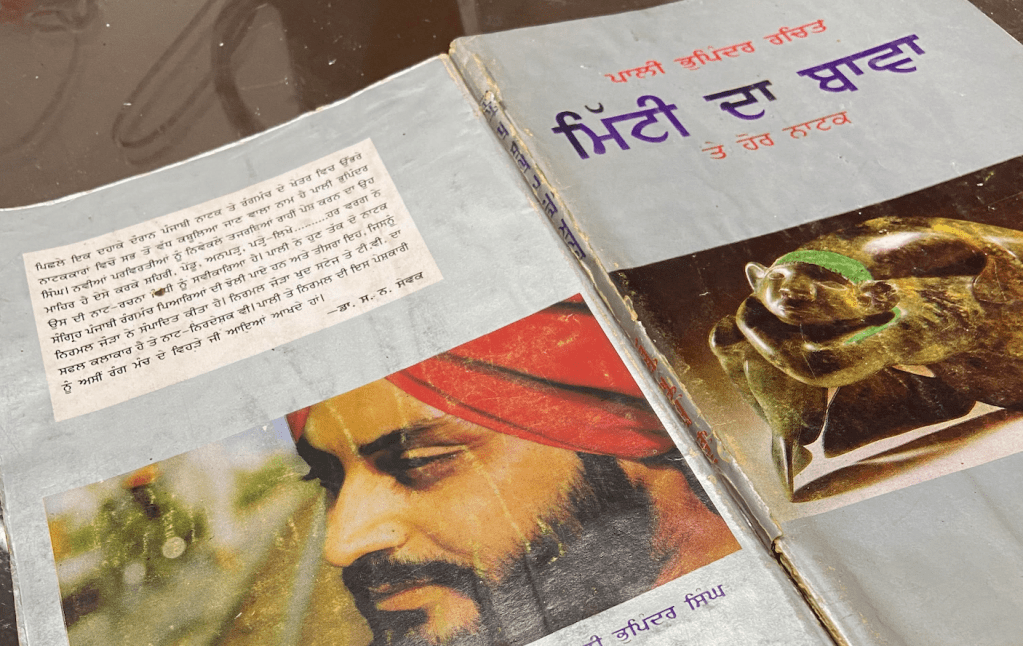
(Mitti daa Baawa (The Clay Doll) by Paali Bhupinder Singh)
I will not attempt to do “zabardasti ki mapping” (forced mapping) on the lines of 10 Lessons Learnt from Mitti Daa Baawa, because that’s overfitting and in some way dishonest as well. I’ll just mention some stuff from the play, do your own translation where it makes sense.
Here are some key moments as they unfold:
- They attack each other the moment they come across one another.
- They stop fighting as a bunch of tribals come their way as their village is burnt by a “shower of fire from the sky”. They hide.
- The tribals locate them. They end up killing a tribal, which they repent.
- They together hide the dead body.
- During this situation, one says “We”, the other asks “We?”, and the first one replies “I mean – You and Me”. This theme repeats later as well.
- They spend the night together as it is safer that way.
- The next morning, one of them finds a broken clay doll – Mitti daa Baawa.
- This clay doll then onwards becomes the medium of communication – e.g. if X has to say something to Y, X will show that he is talking to the clay doll – “Can you ask Y if he has seen a letter which I seem to have lost”. And then Y talks to the clay doll and says – “Tell him, main iske baap ka naukar nahin (I’m not his father’s servant) to find his lost stuff”.
- This continues and then they proceed to divide the area and tell each other that they should not cross into each other’s area. This they soon realise is not a good solution, as something which they like is on the other side e.g. a tree which one had started liking during this time.
- During all of this, they are talking, despite the evident satire and remarks. The talks slowly grow from sheer hate to human understanding and almost affection.
- Every time they reach a point where they have started liking each other, a bomb goes off somewhere and they suddenly come to realise that they are soldiers of the opposing side and the communication changes.
- <Read the play if you can. It’s beauty can not be described. Many events unfold.>
- The Ending – The unit of one of the soldiers arrives in the jungle and his officer asks him to shoot the other soldier. He’s hesitant and the other says that’s what we are paid for – shoot me. The first soldier says he looks forward to the day when this wall fades away, cries, shoots and then salutes the dead one. He deletes the line which they had mutually drawn earlier to mark their territories.
Testers and Developers
Developers solve problems for users.
Testers provide information about quality of these solutions, so that developers can improve the solutions.
Development is a constructive work, so is testing despite the deliberate pessimistic mindset. It’s all in the family.
It is really that simple. So, theoretically there should not be any conflict at all.
Reality, however, is not that simple.
There will be many circumstances, when developers and testers seemingly and at times even really act as if they are on opposing sides.
That’s the time when you should talk about culture in yourself or your organisations.
When you have the luxury of time, budget, it’s easy to appear cultured.
What’s your culture when the bombs are going off? How do I behave as a tester during that time? How does a developer behave during that time? Are we still the same empathetic people? Do our actions show that?
In an organisation, this is where management’s role is extremely critical. Are you creating a team of developers and testers together or knowingly/unknowingly creating a culture where developers and testers are pitched against each other? Is a lack of bugs being found a good news from development angle or a bad news from testing angle? What are your metrics, how do you treat the stories behind those metrics?
Is your core philosophy to punish or to reward?
In the current layoffs situation are you looking at developers and testers in the same way? If not, how will you get a relationship right in the face of inequality?
Equality is the basis of a relationship. In an unequal relationship of testers and developers, what I hear is just a victim’s (or a self-victimised engineer’s) cries.
Isn’t it an irony that most of the posts where it is said that testers are as important as developers, are written by testers?
I remember one (and the only?) example from 20 years of my career where the developers and testers were being managed by two different managers. The Dev manager and the QA manager were in conflict all the time. But the developers and testers weren’t. That’s the only example I remember where we didn’t care about the bombs going off around us. We just chose to care about each other every day. I don’t remember any other consecutive years in my career where I learned as much as I did then.
If tester-developer relationship is compromised, we have already set a bar on where we can reach. Find a way to fix this.
And no, not the patronising, artificial, motivational single liners. And not the victim’s cries. That’s not the way. That will not solve the problem.
Be honest in solving it. Don’t try to look nice. Be nice.
Last but not the least, at any point in time, rarely both the roles are important to the same extent. There will be these importance waves. What we need to worry about is if these waves are always of one kind.
If these waves are always of one kind, it’s not that the waves are of one kind, it’s that our way of looking at them is always of one kind.
That’s all for now.
 Rahul Verma: My Petty Bits
Leave a comment