
What is the meaning of value? We often use this word in the testing world.
What is one’s value system?
This article is about the way I perceive my value system and how my experience has changed it over time.
The Value System Continuum
Let’s start with an example. I’ve had many conversations in the last month about what a Keynote at a conference should be about in my opinion.
What do I consider as a brilliant keynote?
What do I consider as a good talk but not a keynote?
What do I consider as a bullsh*t keynote?
These conversations made me introspect. I realised that my answers for the above have changed over time. Some people would want to try to hold me to something I might have said on this subject 20 years ago. If my answers haven’t changed in 20 years, what was I doing in these 20 years?
Shouldn’t I be an updated version of myself after all these years? Can’t this updated version contradict its earlier opinions and answers? If not, what is experience?
Leave aside 20 years. I think over the past month itself, some of my views are slightly updated.
I was thinking about all this on my way back from attending the Agile Testing Days Open Air conference at Köln this week. Here’s a mental model which I developed to explain this to myself: The Value System Continuum
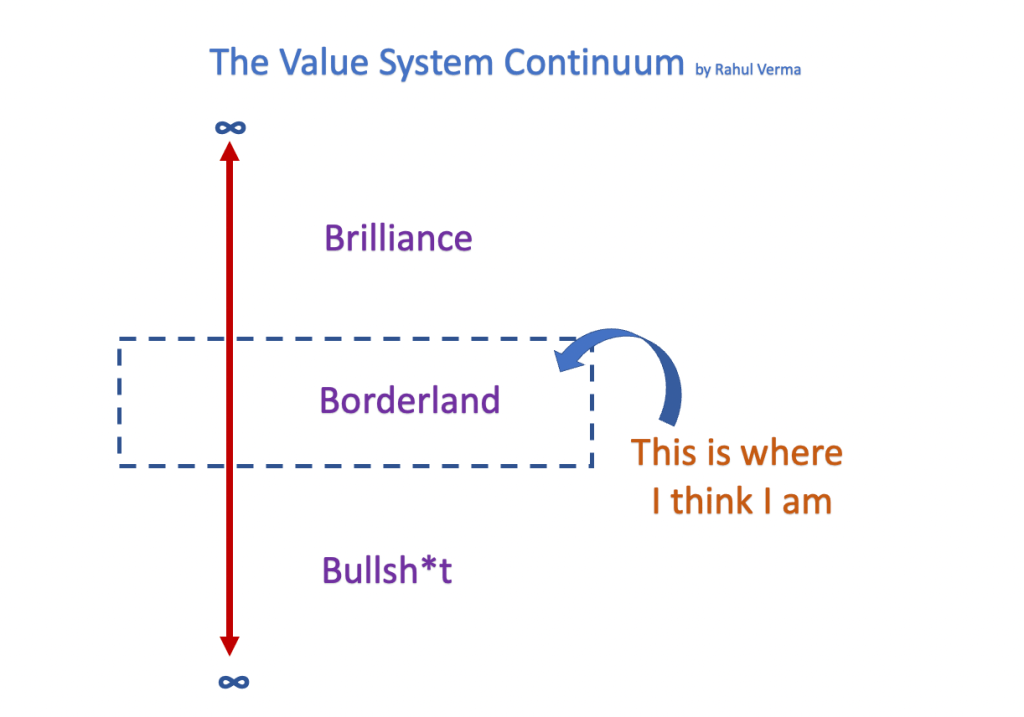
Experience and its Relation to the Value System Continuum
Brilliance
Brilliance is something I don’t have at any point in time. It is also which I consider as brilliant in retrospection even if I have the capability today. As I do better, something I constantly strive to do and am occasionally successful at, my definition of brilliance moves up. My version of brilliance is also biased based on the brilliance of what I have been exposed to so far or my dreams.
The most brilliant keynote for me remains the keynote on Testing Facts and Fiction by Vipul Kocher about 15 years back. His two other talks Extensions to Noun-Verb Technique and Q-Patterns along with this keynote had along lasting impact on me and that’s the reason I’ve always called him my mentor. The most brilliant work on testing which was the need of the time remains for me what James Bach, Cem Kaner and Michael Bolton did during the early years of Context-Driven School. I consider all of them as my teachers. The most brilliant story talk for me was by Jayapradeep Jiothis on the subject of depression – possibly the most honest talk I’ve ever listened to. The most brilliant community contributions in India were by Pradeep Soundararajan which later led to many successful individuals within the community further creating goodness with their own influence. As of today I see Naveen Khunteta, Mahesh Chikane, Brijesh DEB doing amazing and thorough community work. José Díaz (disclaimer: now my boss :-)) is the most brilliant conference organiser I have ever known. On the same lines, I am amazed with the sheer power and presence of Angie Jones . If you haven’t already, locate her work on Java for testers. I see brilliance in terms of dedication as a speaker in Shivani Gaba, as a test leader in Bhavna Varshney and a course content reviewer (linguistic) in Emilie Potin-Suau.
The purpose here is not to list all the names. These are just a few names. For example, as I want to pick up AI/ML, I am looking at Tariq King and Jason Arbon.
Although I’ve mentioned only may be 1-2 things for the said individuals, their brilliance of course spans many more things known and unknown to me.
The people in my Brilliance bucket may have conflicting ideas with each other. I might have disagreements with them. That’s all fine.
What is important is that they have earned my professional respect simply by doing what they do.
Bullsh*t
Bullsh*t is what I consciously want to stay away from. As I have gained experience, I can locate bullsh*t a little quicker than earlier. Also, I am getting older. To retain my sanity, I need to protect myself from stuff which earlier I could have sat through and listened to.
Life is short. If I look at my earlier career I spent a lot of time fighting this zone. Now, I mostly ignore. For the same reason, I hardly comment on such posts on LinkedIn. I question the overall stuff in my own writing, but by spending as little time as possible on such stuff. I will not list any names here.
Borderland
The floating zone between Brilliance and Bullsh*t is the Borderland – this is where I think I am. I’ve become better over time. What was brilliant once is the norm as it becomes a part of me. I hold the work by others that opened this door for me in the past as brilliant though. I think I do not talk bullsh*t or do work of this nature. The word “mostly” is missing there, I guess :-).
Keep in mind, that’s what *I* think about it. Of course, as per your value system, everything I do could fall in the Bullsh*t zone. That’s ok.
What was once tolerable as I didn’t realise its ugliness is pushed to Bullsh*t zone. It includes many things from who I was as well. I remember how when I was a performance test engineer (somewhere in the year 2006), I used to look down upon other “lesser technical” forms of testing. That was bullsh*t. I am not proud of those times but I am not living in guilt as I got rid of that part of my thinking long back (thanks to Vipul’s talk on Extension to Noun-Verb Technique).
When I look around, I see the same pattern of misplaced value in some other good testers. For example, there are some voices on LinkedIn about automation – they talk good stuff indeed. However, they think because they are techies they can look down upon those who talk about the roots of testing. I hope over time they find their own borderland between brilliance and bullsh*t. I see so much of myself in them, the part of myself I am not proud of today.
The Conversation Killer
If I say something as bullsh*t does not mean it is – it is so in my opinion at that point in time. Your opinion is yours.
If I say what I think is brilliant does not mean I think I am that brilliant. It means it is beyond what I can accomplish at that point in time.
Brilliance is sort of a personal dream zone for me where I place work by people which amazes me, even if I disagree with some of it.
If we can have this basic agreement of interpretation, the conversation can continue. Without this foundation, I would rather stay away from such talk where everything is being second-guessed rather than debated upon.
The problem in a conversation is not about a disagreement. The problem is when it goes beyond the disagreement into the world of false assumptions behind that disagreement and adding your own mirch-masala (an Indian way of saying – paraphrasing (wrongly) to make it spicier).
Outliers: The Brilliance-Borrower Wannabes and The Original-Bullsh*ter
I value originality. Originality is mostly not about innovation – true innovation does not happen often. Originality in practice is about having an original discussion. Some of these original conversations have the power to later become an innovation and further the field.
I will give you an example. Since its inception, I’ve been against the concept of “Testing vs checking”. Despite my disagreement, I consider the people behind this concept in the Brilliance zone. They are some of the masters of the art and craft of testing from whom I have learned a lot and continue to learn.
And then of course, there are the borrowers, who will blindly throw the reasoning of testing vs checking in a discussion. When you ask them why, they will give you very superficial answers and more often than not, directly tell you – go read XYZ article by James Bach or Michael Bolton.
Should I engage in a debate over a subject with someone who keeps quoting someone else in the discussion? Wouldn’t I rather go to the source and have a direct debate with them?
If you are answering every question/point with a quote by someone, you are not debating. You are a glorified mouthpiece – that too an unwanted one. The creators of those concepts expected you to own the concept rather than shifting the burden of truth always on them.
I had a conversation with a keynote speaker (he won’t mind taking the name, but I am avoiding it for the others) this week about how some of his followers or people who like him are avoiding me because I had questioned him during one of my talks. Putting forward a challenge respectfully is what I had done. He knows that I respect him professionally and I don’t ask questions to look smarter than I am. I ask what I want to ask. This is what he said about this situation: “This is stupidity. And that’s the reason why after a certain size and time, some communities die or become meaningless beyond the core people who created that community.” He says this about those “wannabes” (the word he used) who are taking offense about what I said to him. I hope you can see the irony.
Tip: I have not seen any of those who are in the Brilliance zone for me, using click-bating to attract others.
To some extent I can enjoy the company and discussion of an original bullsh*ter more than hollow debates with mouthpieces.
Where Does that Leave You and Me
Our value system can be different.
My version of brilliance of something could be absolute bullsh*t for you and the other way around. As an example, I’ve not seen anyone agreeing to what I think about what is a keynote. That’s ok. As long as we both have the freedom to talk about our perspectives openly and safely, what’s the problem?
A polite professional disagreement is a much better conversation than I-scratch-yours-you-scratch-mine conversation.
I try that I am myself in conversations. That way at the least, I am an original bullsh*ter in your eyes. So, you see, no problem there. We can have a conversation.
That’s all for now.
 Rahul Verma: My Petty Bits
Leave a comment